
How to Choose an Engineer for Florida Projects Step-by-Step
Choosing the right engineer can make or break your Florida property project. Whether you are a homeowner navigating flood zones or a commercial owner solving drainage challenges, understanding exactly what skills and credentials your project demands is crucial. Collaboration and a clear grip on your goals ensure you hire someone with the proven expertise needed for Florida’s unique building codes and complex environmental factors. This guide will help you define your needs and select the most qualified professional for lasting results.
Table of Contents
- Step 1: Define Project Needs And Required Expertise
- Step 2: Research Local Engineering Qualifications And Licenses
- Step 3: Evaluate Portfolios And Past Project Success
- Step 4: Check Relevant References And Credentials
- Step 5: Verify Compliance With Florida Regulations
Quick Summary
| Key Point | Explanation |
|---|---|
| 1. Define project goals clearly | Establish a clear core goal and differentiate between desired outcomes and methods to avoid hiring the wrong specialist. |
| 2. Verify engineer qualifications | Always check licenses, education, and relevant certifications to ensure compliance with Florida’s engineering standards. |
| 3. Review project portfolios thoroughly | Request and examine previous projects similar to yours to assess the engineer’s experience and problem-solving skills. |
| 4. Check references for reliability | Contact past clients to gauge the engineer’s communication and consistency based on specific project experiences. |
| 5. Ensure regulatory compliance knowledge | Confirm the engineer understands Florida regulations specific to your project type to prevent costly code violations later. |
Step 1: Define project needs and required expertise
Before you call a single engineer, you need clarity on what your project actually requires. This step separates projects that succeed from ones that stall midway through planning. You are defining both what your project must accomplish and what skills will get you there.
Start by writing down your project’s core goal. Are you building a new residential structure in a flood-prone area? Addressing drainage problems that have plagued your commercial property for years? Planning a renovation that requires structural assessment? Each scenario demands different expertise. When defining your needs, distinguish between your desired outcome and the methods to achieve it. You might want water to stop pooling in your yard (the goal), but that could be solved through grading, French drains, or comprehensive drainage system redesign (the methods). Understanding this difference prevents you from hiring the wrong specialist.
Next, list your constraints and expectations. What is your timeline? Does your municipality require specific permits that only certain engineer types can expedite? Are you working around an existing structure? Does your property sit in a flood zone requiring proper drainage analysis and flood mitigation planning? Florida projects have unique demands—hurricane considerations, soil conditions, high water tables, and coastal regulations shape what your engineer needs to deliver. Write these constraints down. They matter tremendously when you evaluate candidates later.
Collaborate with anyone affected by this project. If you are a homeowner, discuss the scope with your family. If you are a commercial property owner, involve your property manager, tenant representatives, or operations teams. Different perspectives reveal requirements you might miss alone. This collaborative approach ensures your engineer understands not just the technical scope but the real-world context of your project.
Here’s a summary of engineering specialties relevant to Florida projects and when to engage each type:
| Specialty | Typical Projects | Why It’s Crucial in Florida |
|---|---|---|
| Structural Engineer | Residential and commercial building assessments | Deals with hurricane codes and high wind standards |
| Civil Engineer | Drainage, grading, and flood mitigation | Manages stormwater and high water tables |
| Geotechnical Engineer | Soil testing and foundation design | Addresses challenging soil and coastal conditions |
| Environmental Engineer | Permitting and impact analysis | Navigates coastal and wetland regulations |
Pro tip: Create a one-page project summary listing your main goal, timeline, budget range, location specifics (flood zone status, soil type if known), and any existing reports or assessments you have from previous inspectors or engineers. This document becomes gold when contacting engineers—it demonstrates you are organized and serious, and it gives them exactly what they need to evaluate whether they can help.
Step 2: Research local engineering qualifications and licenses
Not all engineers are created equal, and Florida has specific requirements that matter for your project. This step ensures you only consider professionals who meet the legal standards to practice in your state and deliver the expertise your project needs.
Start by understanding what licensure actually means. In Florida, professional engineers must pass rigorous examinations and meet strict experience requirements. The Florida Board of Professional Engineers regulates licensure and requires candidates to earn a degree from an ABET-accredited program, complete qualifying work experience, and pass the Fundamentals of Engineering (FE) exam followed by the Principles and Practice of Engineering (PE) exam. This matters because these credentials prove your engineer has the knowledge to handle complex projects safely and competently. When you review potential candidates, verify their license status on the Florida Board website. You can search any engineer’s name and confirm their credentials are current and in good standing. An engineer without a valid Professional Engineer license has no business stamping plans or taking responsibility for your project.
Beyond the PE license, consider what specialty your project demands. A structural engineer working on a residential foundation needs different credentials than a civil engineer designing your drainage system. Florida projects often require expertise in flood mitigation, drainage design, and soil analysis. Engineering licensure requires education, work experience, and examinations that demonstrate competence in specific disciplines. Ask candidates directly about their experience with projects similar to yours. Have they handled flood zone properties? Do they specialize in drainage systems? Have they expedited permits for residential renovations? Their years of experience and project portfolio reveal whether their licenses translate to real-world competence for your situation.
Also verify that the engineer maintains continuing education requirements. Florida requires licensed engineers to complete professional development hours to keep their licenses active. This ongoing education ensures your engineer stays current with building codes, regulations, and best practices. When you contact an engineer, ask about their professional memberships and recent training. Engagement in professional organizations and current certifications show they take their craft seriously.
Pro tip: Before scheduling a consultation, request the engineer’s license number and verify it independently on the Florida Board of Professional Engineers website. This takes five minutes and protects you from hiring someone misrepresenting their qualifications—a surprisingly common problem in competitive markets.
Step 3: Evaluate portfolios and past project success
A resume tells you what an engineer claims to have done. A portfolio shows you what they actually accomplished. This step separates candidates who talk a good game from those who deliver real results on projects like yours.

When you request portfolios from candidates, look for documented examples that match your project type. If you need drainage system design, ask to see completed drainage projects in Florida. If you require structural assessment for a residential renovation, request examples of similar residential work. Engineering portfolios showcase documented design processes and project outcomes, giving you concrete evidence of their capabilities. A strong portfolio includes not just pretty renderings but actual project documentation. Look for site plans, calculations, before and after photos, and evidence of permit approval. These materials prove the engineer can move a project from concept through completion and satisfy regulatory requirements.
Beyond the pretty pictures, dig into the problem-solving approach. Ask the engineer to walk you through a past project step by step. How did they identify the core problem? What solutions did they consider? Why did they choose their final approach? Did they encounter unexpected challenges and how did they resolve them? This conversation reveals whether the engineer understands the full engineering design process from problem definition through testing and redesign. An engineer who can articulate their thinking process demonstrates maturity and thoroughness. Someone who glosses over details or cannot explain their decisions raises red flags.
Also pay attention to client testimonials and references. Ask for contact information from three to five previous clients and call them. Ask specific questions about the engineer’s communication, timeliness, problem-solving ability, and whether they would hire this engineer again. A reference who hesitates or gives qualified praise tells you something important. Look for patterns across multiple references. If everyone mentions the engineer’s responsiveness and attention to detail, that matters. If feedback varies wildly, that suggests inconsistency.
Finally, notice whether the portfolio includes projects similar in scope to yours. An engineer who specializes in massive commercial projects might lack the detail orientation your residential foundation assessment requires. Conversely, someone experienced primarily in small residential work might struggle with the complexity of your commercial property’s drainage system. The best candidate has meaningful experience with your specific project type in Florida’s unique environment.
Pro tip: Request at least three portfolio examples that closely match your project type, and ask for permission to contact those clients directly. A confident, experienced engineer will welcome reference checks because their past clients will confirm their quality.
Step 4: Check relevant references and credentials
You have narrowed your choices based on licenses, portfolios, and initial conversations. Now you verify that the credentials are real and that past clients genuinely stand behind this engineer’s work. This step takes time but prevents costly mistakes down the road.
Start by requesting a list of professional references from each engineer you are seriously considering. Ask specifically for recent clients from projects matching your scope. An engineer who worked on five drainage projects in the past three years gives you better insight than someone who handled a drainage job ten years ago. When you contact references, go beyond “Would you hire them again?” Ask about specific situations. How did the engineer handle unexpected site conditions? When problems arose, how quickly did they communicate and propose solutions? Did they stay within budget and timeline? What would they do differently if they hired this engineer again? These detailed questions reveal patterns. A truly excellent engineer gets consistently high marks across all areas. Someone with mixed feedback raises questions about consistency or specialization.
Beyond client references, verify the engineer’s professional credentials through official channels. Professional engineering credentials validate education, experience, and ethical standards to protect public safety. You already verified their PE license through the Florida Board website. Now check if they hold any specialty certifications relevant to your project. Someone claiming expertise in flood mitigation should hold credentials in that area. Ask about professional association memberships. Engineers who belong to groups like the National Society of Professional Engineers demonstrate commitment to staying current with industry standards and ethics. Request proof of continuing education compliance. Florida requires licensed engineers to complete professional development hours annually. An engineer who maintains these requirements shows they prioritize staying updated on code changes and new technologies.
If an engineer received their degree outside the United States, request documentation of credential evaluation. Credential evaluations verify that international engineering education meets U.S. standards equivalent to ABET accreditation. This ensures their background qualifies them for Florida licensure and that their training aligns with American engineering standards and practices.
Do not rely solely on references provided by the engineer. Go the extra step and ask if you can contact one previous client who was unhappy or experienced challenges. A willingness to discuss problems honestly indicates confidence and maturity. Someone who refuses or becomes defensive tells you something important about how they handle difficult situations.
Pro tip: When calling references, identify yourself as a potential client and explain your project briefly, then ask if the reference would recommend this engineer specifically for your project type. This frames the question around fit rather than general quality, giving you more actionable feedback.
Step 5: Verify compliance with Florida regulations
Your engineer needs more than a license to practice. They must demonstrate understanding of Florida’s specific building codes, environmental regulations, and compliance requirements that vary from other states. This step ensures the engineer you hire knows exactly what Florida demands for your project.
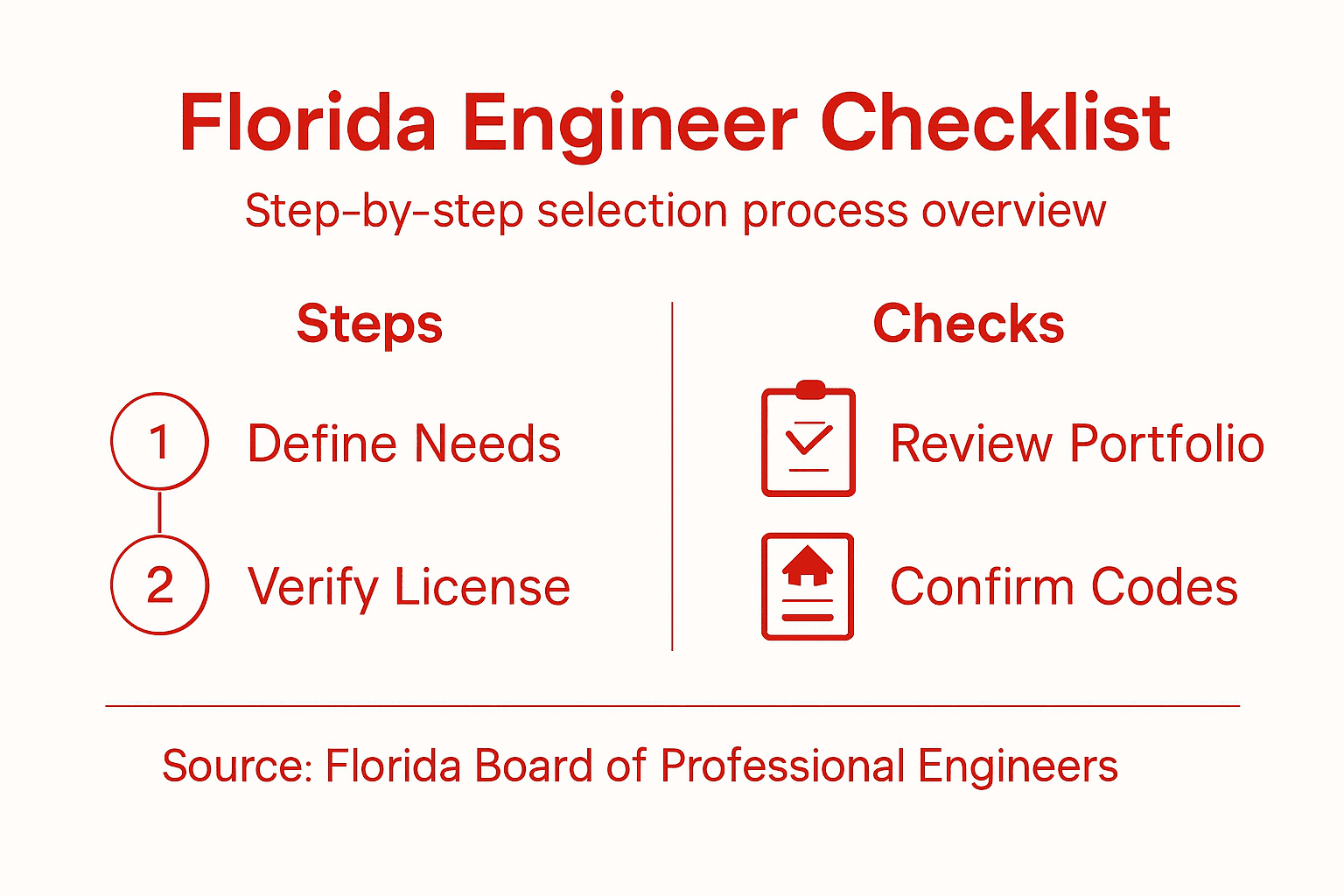
Start by asking each candidate about their familiarity with Florida Building Code requirements specific to your project type. Florida has unique regulations around flood mitigation, drainage, wind resistance, and soil conditions that differ significantly from national standards. An engineer claiming expertise in residential construction but unfamiliar with Florida’s flood zone regulations and elevation requirements is a liability. Ask them to describe recent projects where they navigated Florida’s specific requirements. How did they handle elevation certificates? What about no rise certifications for flood mitigation? Can they explain the differences between flood zones and how each affects your project? Their answers reveal whether they genuinely work in Florida regularly or just claim to.
Understand that Florida Building Code Chapter 17 outlines special inspections and testing requirements for structural and material standards in construction projects. This means your engineer must specify independent inspections at critical phases of your project. They need to know which phases require inspection, what documentation is needed, and how to coordinate with special inspectors. Ask candidates how they manage the inspection process and whether they have established relationships with qualified independent inspectors in your area.
Also verify that your engineer understands Florida Board of Professional Engineers compliance standards including continuing education requirements, professional conduct rules, and record-keeping obligations. An engineer who mentions these standards unprompted demonstrates they take regulatory compliance seriously. Ask about their approach to documentation. How do they maintain records? How do they communicate with municipal agencies? What happens if building officials require modifications to their design? Their answers should reflect respect for Florida’s regulatory environment and a systematic approach to compliance.
Before finalizing your choice, request written confirmation that the engineer will ensure your project meets all applicable Florida regulations and codes. This written commitment becomes valuable documentation if issues arise later. Ask them to specify which codes and regulations apply to your particular project. A vague response indicates they have not thoroughly analyzed your project. A detailed response shows they have done their homework and understand exactly what compliance entails.
Compare these engineer vetting steps to understand their focus and benefits:
| Step | Primary Focus | How It Protects Your Project |
|---|---|---|
| License Verification | Ensure legal competency | Prevents hiring unqualified engineers |
| Portfolio Review | Assess relevant experience | Confirms successful outcomes on similar jobs |
| Reference Checks | Validate reputation and reliability | Gauges communication and consistency |
| Regulatory Compliance | Confirm Florida code expertise | Avoids costly code violations and delays |
Pro tip: Ask your candidate engineer to provide a one page checklist of Florida regulations and permit requirements specific to your project type, then verify this checklist with your local building department before hiring. This reveals whether the engineer truly understands your municipality’s requirements and prevents surprises during the permitting process.
Find the Right Florida Engineer with Confidence
Choosing the right engineer for your Florida project is critical to avoid costly mistakes and ensure full compliance with local regulations. From understanding flood mitigation requirements to securing elevation certificates and no rise certificates your project demands precision and expertise. If you are feeling overwhelmed by the complexities of navigating Florida’s unique building codes and engineering standards trust the experts who specialize in these exact challenges.
Explore our Engineering and Inspection Archives – Florida Licensed Engineers to see how we handle permitting expediter services and comprehensive civil engineering solutions. Our team delivers detailed architectural, structural, mechanical, electrical, and plumbing plans tailored for both residential and commercial projects. Whether you need expert drainage, grading, or flood zone analysis you can count on us at Florida Licensed Engineers to provide clear project summaries and coordinate all inspections with your local building department. Act now to secure a partner who understands your project’s goals and Florida’s regulatory demands fully. Contact us today to get started and ensure your project moves forward smoothly and successfully.
Frequently Asked Questions
How do I define my project needs before contacting an engineer?
To define your project needs, outline your core goal, such as building a structure or addressing drainage issues. Additionally, identify constraints, such as timelines and permits required, to ensure clarity when discussing your project with potential engineers.
What qualifications should I look for in an engineer for Florida projects?
Look for engineers who hold a valid Professional Engineer (PE) license in Florida and have specific expertise relevant to your project type, like structural or civil engineering. Verify their qualifications through official state resources to ensure they meet legal standards.
How can I evaluate an engineer’s previous work for my project?
Request portfolios from potential engineers and look for documented examples similar to your project type, such as completed drainage or structural work. Ensure the portfolio includes evidence of their project outcome, like permits or site plans, which demonstrates their capability.
What questions should I ask during reference checks for an engineer?
During reference checks, ask previous clients about the engineer’s problem-solving skills, communication, and adherence to budget and timelines. Specifically inquire how the engineer handled challenges during the project to gauge their ability to manage issues effectively.
Why is it important to verify compliance with Florida regulations?
Verifying compliance with Florida regulations ensures that the engineer understands the specific building codes and environmental requirements that apply to your project. This prevents costly mistakes and delays by ensuring all necessary standards are met throughout the project.
How can I ensure the engineer I choose understands local regulations?
Ask candidates detailed questions about their familiarity with Florida’s Building Codes and regulations specific to your project. A qualified engineer should confidently explain recent projects that required compliance, demonstrating their understanding of local requirements.
Recommended
- Inspection Types Explained: What Florida Projects Need – FloridaLicensedEngineers.com
- Engineering Project Workflow: Florida Compliance and Success – FloridaLicensedEngineers.com
- Engineering Project Workflow: Florida Compliance and Success – Florida Licensed Engineers
- Inspection Types Explained: What Florida Projects Need – Florida Licensed Engineers
- Highway Gateway Plaza – Rendimension
